Bridge Talks is back in 2018 starting with 'A Night with the Dorchester Collection' on June 12. Eugenio Piri, Chief People and Culture Officer, opens up the doors to the amazing cultures that support their businesses. The event will look at the important role that all employees play in delivering an outstanding customer experience and share their journey to putting in place a business case for culture.
Dale Smith is well-versed in Emotional Intelligence and neuroscience and leads the development of new theories and programmes on behalf of Bridge. He is a master practitioner of NLP with degrees in Psychology/Sociology and Business Marketing as well as an accomplished international speaker and facilitator and has presented at several industry conferences and events. He has worked extensively with clients in both the UK and abroad in Employee Engagement, business transformation and building organisational cultures that best reflect the brand promise.
Liz Pannaman
Organisational Development Specialist - People Transformation, TfL
Learning and development specialist and corporate performance coach and trainer, specialising in leadership and personal effectiveness. Industry recognised for her skills in performance management, success planning, strategy, and HR transformation.
Chieu Cao
Co-founder & CMO, Perkbox
Before co-founding Perkbox, the UK’s fastest-growing employee engagement platform, Chieu established himself as a tech marketing force to be reckoned with, leading initiatives for brands including Microsoft, Amazon and Yahoo. A consultant turned CMO, Chieu's repertoire spans both B2C and B2B, from SEO to social strategy.
Tim Pointer
HR Director, Dixons Carphone
Tim is not only a Global HR Director but also an organisational consultant, executive coach, speaker, CIPD award winner and business culture expert. He has a broad-based global experience across both FTSE 100 and large-scale private family businesses, specifically in the European, North American and Asia-Pacific markets. A comprehensive understanding of branded business, with a background covering the FMCG, performance goods, fashion, technology, retail & e-commerce, and liquor sectors.
Ben Gateley
Founder, CharlieHR
Ben is a co-founder and COO of CharlieHR: a free, cloud-based HR toolbox used by thousands of small businesses worldwide. Having started and grown a number of successful companies since his teenage years - including BORN SOCIAL, one of the largest social media agencies for challenger brands in the world. An outspoken champion of positive workplace culture, frequent volunteer and engaging public speaker, Ben is a passionate advocate for all things “people”.
Elizabeth Hampson
Director, Health Strategy Consulting, Deloitte
Elizabeth leads health policy and commercial strategy projects for central government, industry and leading health charities across Europe. Over the last decade her clients have included all types of organisations across the health economy: European central governments, major industry players (pharma, med tech and private providers), healthcare providers and leading charities. Health policy and strategy experience across EMEA has given her a breadth of perspectives on whole-system challenges in health and those faced by the individual participant organisations. Elizabeth is committed to delivering exceptional service to clients and developing the skills of her team. She has practical skills, backed with strong academics, which include an MSc in Health Economics and Policy from London School of Economics, the Chartered Financial Analyst qualification and recently a PG Cert in Coaching.
Philip Luce
Hospital Director, Bupa Cromwell
Philip Luce is Bupa Cromwell Hospital’s Director. Philip started his career at the Cromwell in 2011 as the Cardiology & Medical Directorate Manager, before becoming Operations Director a couple of years later – heading up the refurbishment of all wards, and overseeing the clinical teams in the day to day running of the hospital. In 2015, Philip took on the role of Director of Bupa's nationwide network of Health and Dental Centres, during which time Bupa acquired the Oasis chain of dental centres, making it one of the biggest providers of dental services in the UK.
His extensive career in private healthcare began as a Cardiac Physiologist before taking on the Cardiology Manager role at HCA, working across a number of hospitals including the Lister and London Bridge.
Christina Liciaga
Head of Customer Service, HSBC
Entrepreneur turned international finance executive with experience in emerging and mature markets across Asia, Europe, Latin and North America. High Net Worth business development influencer, advising large corporates on people-first post-merger integration opportunities, developing client segmentation strategies, and building and leading the global award-winning wealth proposition, Jade by HSBC Premier. Passionate leader who builds and transforms teams through authenticity and curiosity to embrace innovation, embed change, and deliver commercial growth; translating strategy into reality.
Jonny Gifford
Senior Advisor for Organisational Behaviour, CIPD
Jonny Gifford is Senior Advisor for Organisational Behaviour at the CIPD. He has extensive experience conducting applied research into employment and people management, including in previous roles at the Institute for Employment Studies and Roffey Park Institute. Current interests include job quality or ‘good work’ and behavioural science insights into aspects of HR such as performance management. Jonny runs the CIPD Applied Research Conference and actively promotes evidence-based practice, including through systematic reviewing and running randomised trials. He is an Academic Member of the CIPD and a Fellow of CEBMa, the Center for Evidence-Based Management.
Maggie Tambe
Head of Customer Relations, Peabody
A strategic leader who works hard to provide a sense of direction as well as building ownership and alignment within workgroups to successfully implement change. Judge for the 2017 UK Complaint Handling Awards and nominee for the WOW! awards 2017 recognising customer service excellence. Has worked with Family Mosaic since 2011, and played a key role in their merger with Peabody Trust.
Simon Lewis
Owner, Eau Palm Beach
Simon’s area of expertise is in global hospitality for LFH, the private family business behind River Island and a global real estate portfolio. Regularly challenging employees and colleagues beyond their comfort zones, Simon uses his relaxed manner to constantly stretch their knowledge, understanding and skills to boost performance and achievements. He combines 25 years experience in brand values, destination marketing and sales strategies associated with the travel, tourism and hospitality industries to develop creative solutions which achieve consistently measurable often award-winning results. In 2007 Simon conceived, developed and opened a multi-award winning luxury Spa business in the US. In 2013 he was instrumental in creating and implementing a new cultural identity for the 5 star Eau Palm Beach Resort in Florida. Here his work encompasses the complete values set, which underpins the core identity of the business from guest touch point to employee engagement.
Chloë Marsh
Head of Engagement, RHP
With experience in Communications, L&D and HR, Chloë’s passionate about the link between highly engaged employees and better business results. Her expertise has helped RHP to be named as the most innovative housing provider in the UK three years in a row, gain Investors in People Platinum and place number 7 in the 2018 Great Place to Work list. Over the past two years, her team has been integral in getting both customers and employees ready for the launch of RHPi, the UK’s first digital-only housing service. They’ve continued to build engagement across all digital channels and today 70% of interactions are made online.
Becky Thoseby
Group Head of Wellbeing, Department for Transport
Becky owns the wellbeing offer for employees of the Department for Transport and its agencies. Her primary focus is on creating a culture of wellbeing at DfT. Recent work includes;
- running DfT’s first employee wellbeing survey, a diagnostic tool to target interventions where they are most needed - designing and delivering training for senior leaders focused on developing self-awareness and behaviour change, - changing the picture we paint of a high performer to recognise that colleagues with wellbeing issues can still be high performers if the issue is managed well - providing coaching to individual senior managers to address wellbeing issues arising in their areas.
Becky also practices as a well-being coach, both privately and as part of her role, and delivers mindfulness sessions within DfT.
Myra Cooke
Head of Performance Talent & Development, Virgin Atlantic Airways
Myra is a business-focused OD leader with more than 15 years’ experience in a global remit within complex global and domestic industries providing expertise to link development initiatives to strategic business objectives and achievements. Currently Head of Talent and Performance at Virgin Atlantic Airways & Virgin Holidays; she is responsible for the Talent, Performance, Leadership Development and Diversity and Inclusion strategy across Virgin Atlantic and Virgin Holidays. Myra has previously held senior HR and Talent and development roles within organisations including, Veolia, Royal Mail, Priory Group and Dimension Data.
Helen Watson
Senior Strategist, Ogilvy Healthworld
A digital professional with over 15-years experience of delivering communication strategy and user centred solutions for clients. Helen designs engaging, customer-focused omnichannel experiences that meet both the customer and business needs. With experience across a broad range of technologies and channels, uses this knowledge to deliver multi-technology, creative and engaging user experiences for the Healthcare space.
About the conference
Linking Employee Engagement and the Customer Experience as One.
Hear from top speakers and well-known brands on case studies and best practice in various industries. We have gathered speakers from organisations well known for their culture and employee experience, and asked them how they did it.
It is often said that Brand and Culture are two sides of the same coin and coexist as one. The brand makes the customer promise and sets the bar on the projected personality and expectation of the emotional connection. On the other side of this coin sits the culture and the real-time delivery and support of this customer experience, trust and loyalty. Hence, if these two entities require the balance of the other to remain healthy and prosperous in the marketplace then why do so many organisations still refrain from investing at an equal level between the brand that wins the business and the culture that both wins and maintains.
Calling For Conversation
A company culture is a living breathing entity all on its own and in this life force, it requires key elements to be at its best. It is more unpredictable but clearly stated it requires constant emotional nourishment, structure and a visionary purpose for existing – to name a few.
It is not a scientific formula that always behaves as it did in the past or a replication equation that can be mastered and left on a shelf to never change. Businesses behave like humans because they are driven by humans and therefore are always in a constant state of flux, shaping and changing with the tides of time. It – as with people, is always at risk of harm and behaves irrationally when felt to be under threat. To flourish it must be supported by a connected community that lives with equality and passion. Individuals driving the culture must add value to the greater good and be given opportunities to execute this power.
I believe that it is time that we take a more serious look at businesses and change, the lens that many put on culture. Every brand and company culture is different, just as every human on the planet is unique and hence investment will fluctuate based on many circumstances. The secret sits within the DNA that both the Brand and Culture share and how the behaviour of one can have a dramatic impact on the performance of the other. Just with this information alone, it makes sense that a supported and connected culture is more likely to offer a higher degree of allegiance and protection to the brand it is part of.
The key sits in developing a visible and active employee campaign that celebrates the culture through various mediums and is unique to them. Yes, there will be a great deal of commonality that can be applied to all businesses in terms of structure and engagement techniques of staff. However, to truly stand out and have an internal community that is self-driving and healthy then it must be openly supported by the senior leadership team. They must be more active and present in bringing the brand to life through the culture. They must be seen to be investing both time and money in ensuring that the community has opportunities to succeed outside the daily tasks of their role.
This does not mean paying lip service to its development and ticking the box on engagement as if it was just another matrix or spreadsheet that can calculate return on investment in a given quarter. While many people feel the benefits of having a healthy culture, it can be hard to translate those feelings into a language that an executive team understands or can quantify in the monthly reports. In order to make a compelling case to invest in a company culture, we have to move culture from the realm of “fluffy people stuff” to the land of long-term investment and business strategy. However, we really must start taking the data more seriously as it will show the connection to the ROI of the business if proactive in its collection.
The Future of Investment in Culture
In building the business case for culture we have to be prepared to be more innovative and challenge the status quo. With these early days of discovery, we need to take risks and with each opportunity invest additional support to gather the real-time insights into the challenges and positive outcomes of the transformation. This Intel will be invaluable when building a future case for culture, as it will need higher-level support. Many organisations have made some incredible inroads into putting culture as the top priority in business performance however, I still see the continuation of the ideal that the business requires only structure to maintain order, whether that is departments, hierarchy, process or policies. This stuff just keeps it moving day-to-day, month-by-month and if done well, profitable.
Don’t get me wrong, I fully appreciate the value that this structure brings to a business and its place in maintaining order. But let’s also be real and see the darker power that can come from too much structure as it creates divides, complications for those without full access to information and a place for non-effective leaders to hide. As long as key individuals are only focusing on structure and its tangible and measured outcomes, the investment in the perceived risky success of ›4›‘culture stuff’ is left to the side. More and more data is coming to the forefront to show that investing in building a great culture means that you can also flip the coin on some of the structure and the team becomes empowered and self-governing.
Putting in place a culture plan that brings people together with an opportunity to be recognised, sharing key information openly, honest emotions, vision, and being seen and listened to as valued citizens just makes sense. The big question that needs to be addressed is how to measure this and best convince those within the senior team that it has true value and offers long-term strategic growth prospects to the business. Culture is often dismissed as a “soft” topic that doesn’t offer a tangible business impact. Luckily, research studies and internal data is making it easier to start telling a compelling, data-driven story that will inspire executives to invest in their employees and company’s culture more.
Companies with satisfied employees have a higher percentage of satisfied customers, contributing to higher gross margins, higher repeat business, and reduced acquisition costs! Gallup’s periodic meta-analyses of employee satisfaction studies consistently find that: Business units with more satisfied employees tend to have higher productivity and profitability and lower incidents of safety violations and shrinkage. We now know the impact it can have but we also have to detail the innovative way that this culture will best respond – making the investment worthwhile.
In my 20 years experience in working with organisations on people solutions, I have found a high number of top-level executives that have an overly optimistic view of their own employees’ level of engagement. In hosting frontline focus groups discussing their daily lives within the business it is clear that this picture is not reality. Hence it is important to build on the antipodal information with some hard data that can be found in various sources. In building your case for more investment in the culture, ensure that you can both paint an accurate picture of the current culture and one of its future.
Gather specific numbers around employee engagement and satisfaction through surveys but also delve deeper into things like retention metrics, participation in optional employee activities, personal development requests, real-time captured employee feedback, customer experience feedback and glass door reviews. Behind this insight also sits a great deal of information about some of the required solutions that will ignite the culture. It is always important to listen to what the culture finds most valuable in building a stronger more connected community.
One last tip: Keep your findings up-to-date in an easily digestible format and continuously get them in front of your leadership team. Share real employee success stories as part of this data as it also needs to have a face to represent it. If your project is having an impact, you and your executives will want to know about it in real-time. If it is less than expected you have the opportunity to make changes in the ‘now’ as remember there is no guarantee we will always hit the mark the first time out. Culture is a journey that will shift direction during your organisation’s natural lifecycle as your employees and priorities change, hence it requires constant attention and influence.
Aspire2inspire Dyslexia CIC is a charitable organisation based in Wandsworth, bringing awareness of Dyslexia within the community and encouraging entrepreneurship amongst dyslexics. A2i supports dyslexic adults who want to return to education, apprenticeships, self-employment and we also offer employability skills.
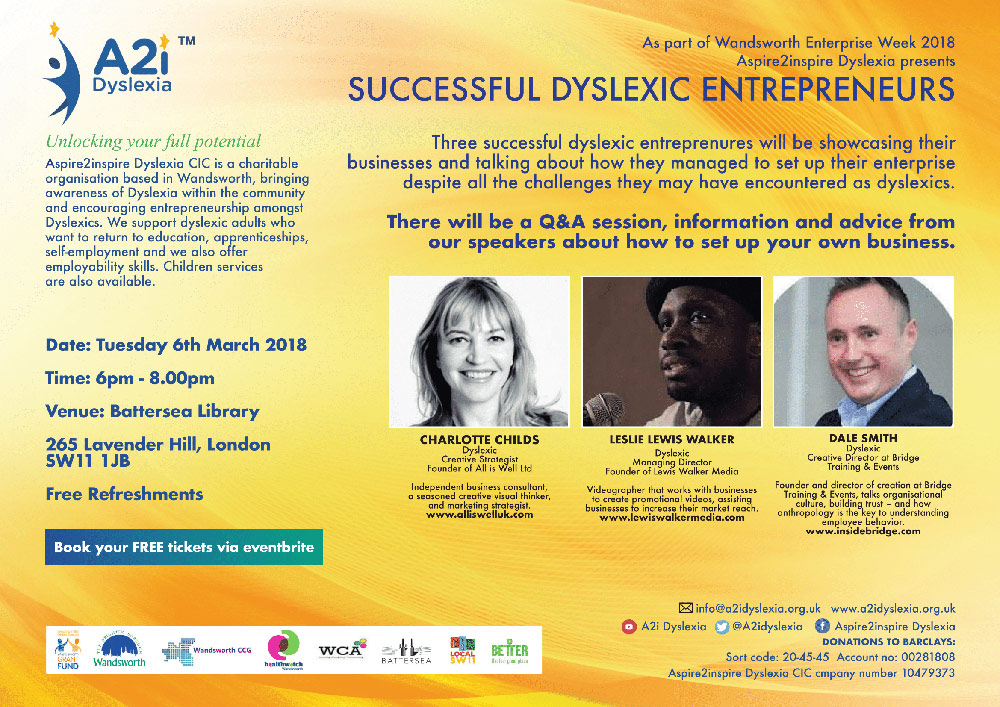
As part of Wandsworth Enterprise Week 2018, three successful dyslexic entrepreneurs, including Bridge’s Creative Director, Dale Smith, will be showcasing their businesses and talking about how they managed to set up their enterprise despite all the challenges they may have encountered as dyslexics.
6:00 – 8.00pm | Tuesday 6th March 2018
Battersea Library
265 Lavender Hill
London SW11 1JB
“You’re every bit as much a brand as Nike, Coke, Pepsi, or the Body Shop. To start thinking like your own favorite brand manager, ask yourself the same question the brand managers at Nike, Coke, Pepsi, or the Body Shop ask themselves: What is it that my product or service does that makes it different?”
I never wear a tie. One of Bridge’s values is “Keeping it Real and Fun” – and ditching the tie means I keep it real and relatable. I use personal stories (almost every presentation includes one about my mum) and inject humour into my facilitation and keynote addresses. By staying true to who I am, I’ve built an authentic personal brand. The more authentic your leadership brand, the greater success you’ll have when living it. Humans are drawn to real, authentic people, not made up personas, so you need to embrace this to differentiate your brand.
As a brand specialist working with across a range of industries, my work often begins with an explanation of how, at the core, all brands have a unique set of values, a vision and a personality; ideally complemented with a clear direction and purpose; much like people.
“Your brand is a perception or emotion, maintained by somebody other than you, that describes the total experience of having a relationship with you.”
David McNally & Karl D. Speak, Be your own Brand
A strong personal brand is the successful self-packaging of who you are and what you stand for: your values, beliefs and purpose, expressed by what you do, and how you do it – including how you look and how you sound. When it comes to my own personal branding, one facet of which I had not been specifically conscious was how I dress and the colours I wear, and the affect that it has on how I am perceived by others. As part of my exploration into building a leadership brand, and in pursuit of my theory that ‘businesses are driven by humans, therefore behave like humans’ I had the opportunity to spend the day with Jackie and Helen at House of Colour.
House of Colour promises to ‘help you to look fabulous and radiate confidence in the colours and shapes that suit you as an individual’; offering master classes in colour, fashion and make up. Their philosophy is that when you look amazing, that’s the real you: “Your face lights up, your eyes sparkle and everyone pays you compliments.”
My day at House of Colour was spent looking at the power of colour, clothing and accessories in building confidence and in projecting the most positive version of myself, starting with the with the colours that best suited my skin tone. As humans, we have a relationship with colour and this experience enlightened my to the way that we choose colour in demonstrating our personality, and how sometimes colour chooses us.
Above: Watch what happened during my day with House of Colour
Based on what I took away from my day at House of Colour, becoming conscious of my outward projection, I wanted to put together some quick tips on building an authentic personal brand – one that projects a positive perception to the external world.
Ask yourself why.
Firstly you need to establish why you want to define your personal brand. An exercise in building your personal brand is an exercise in self-awareness and one that all people should embark on. Are you looking to move into a new career or gain a promotion? Are you looking to master an environment in which you want more control? To understand how this brand will add value to your desired future state is very important, and this step will help you to visualise in the later steps, when you are ready to unleash your brand.
Identify Your Brand Values
Like every brand, having a core set of values is key to guiding you and ensuring your brand maintains its integrity. Remember that these values will be the support network that underpins the actions and behaviours that bring life to your brand. An authentic brand will align with your core values, so take some time in defining these.
The list of values need not be extensive, and should be manageable and a true representation, personally and professionally. For example, if ‘innovation’ is one of the values that you respect in yourself and desire from others, then put this to the test by outlining actions that will bring the value to life. Always remember that your values are yours to own and are the gifts that have been given through life’s journey.
What will be your icing on the cake?
As with all brands, it is important to recognise what will really make you stand out. What is your USP? To find this, you will need to tap into your true passion in life – what excites you? How does this passion define the unique parts of your brand?
“Differentiation is one of the biggest factors contributing to a strong and successful personal brand, and the core of finding what differentiates your brand is typically embracing something unique about yourself.”
Your brand must encompass your true passion and purpose in life; embody your heart and mind and be the best reflection of you. Passion is yours to own and no one else can define this for you – so whatever it is, it helps you celebrate your uniqueness.
Look and sound the part
The devil is truly in the detail – I have seen many corporate brands miscommunicate their message or fail on execution. In corporate branding, we use terminology like ‘company voice’ to describe the way a brand sounds in its written and verbal messaging – the language it uses. For example, Coca Cola is always positive and happy, Innocent’s tone of voice is well known as laid back, playful and humorous and Mailchimp is tongue-in-cheek; whereas a government agency is more likely to use formal, easy-to-understand verbiage. The key to authenticity in your brand voice is a strong connection to your values, in written and verbal communications. When your voice is a reflection of what you believe in, it’s more likely to resonate with the people you are trying to attract.
From website design to advertising, to colour choice in a logo – it all says something about the promise and the personality of the people behind the brand. Yellow for the familiarity and warmth of McDonald’s arches; green for Starbucks’ sustainability and harmony; white for Apple’s intuitive and simple interface, purple for that luxurious, royal service of Virgin Atlantic (despite the red logo!).
Colour and emotion are intrinsically linked in both how we feel about ourselves and how the world sees us. This is no different when building your personal brand as all the choices that you make from the way you dress to the language you use plays part in the continuity and consistency of your brand projection.
Know Your Audience
Always be clear on your audience and ensure that you have enough flex in your personal brand that you can work openly with more than one audience profile. Being authentic means that you are unlikely to appeal to everyone, however you still have the ability to bring your light to a broad spectrum of people. A strong brand will naturally attract like-minded individuals, but also self-awareness will allow you to gain respect and build a connection with your audience without overpowering them with ‘100% real and authentic’ you.
Building your personal brand is not about being set in stone or having the attitude of ‘ this is how I am – take it or leave it!’ To gain self-awareness, you will need to seek out honest feedback from trusted friends, family members or advisors. In the early stages of building your personal brand, it is important that you practice humility and are prepared to take advice.
Great brands maintain a high level of self-confidence and have the ability to unite people from all different walks of life, but always remember that not everyone is your customer. It is important to stay true to yourself, and as with all clearly defined brands, your projected personality must be aligned to your unique offering.
Take Pride in your Brand Story
In the last few years, many companies have invested heavily in defining their brand story and making this the foundation for both their marketing and brand positioning. A brand story is exactly what it says on the tin – the journey that the brand has taken to reach the current state of who and where it is in its life cycle. It can be a collection of anecdotal stories that when brought together give the brand a sense of humanity.
From success to struggle, this narrative allows customers to forge a stronger connection to a virtual brand entity. This is no different when building your personal brand, in terms of having a better connection to your life journey. The stories that truly define the authentic you are the key to your sustainable success. Life has brought us all love, joy and pain; but when framed correctly, it is your unique story and one that will always make the best version of you.
Have some fun in building your leadership brand.
Learn to laugh at yourself, embrace your best qualities and be clear on your intent. All brands behave in a similar way as they share a commonality in knowing who they are and what they stand for. They are clear on the way they project their personality through each of their chosen mediums and are led by a higher purpose. Many great brands have changed the landscape of business forever, as have many individuals. So when building your personal brand, always remember that the best version of you will positively impact and influence many people. Stay true to yourself and keep your intent pure. The recipe for success sits in self-awareness, humility and bringing all of your best qualities to the forefront and sharing these openly with the world around you.
Engaging with the Unknown: Taking a break from it all to gain motivation.
This week, I have faced my fear of the unknown and ventured to Portugal on a mindfulness, meditation and yoga retreat. This is something that I have considered doing for years; always finding reasons not to offer myself the gift of inner awakening. However, as part of The Human Element, it is imperative that I immerse myself in new challenges with an open mind in my quest to better understand the connection between how people behave as individuals and as part of the collective of organisational culture.
Sharing my journey with 24 others, I have entered the world of collaborative working at its best. The word ‘transformation’ has been openly used, but not once have I heard discussions about ‘change’; a word that is often over-used in the world of business. The 24 individuals with whom I have shared some of my innermost thoughts are also on their own personal journeys, much like that of any company culture. What I learned early on in the week is that the secret is not needing to build something new, but tapping into the positive and powerful essence that already exists inside of us.
When I looked more closely at my own experience, I could see how leaders can be more authentic champions for transformation by drawing parallels between their own personal journeys and the organic state of all businesses. We are in the constant flux of change, but we must look to our strengths and those of employees to build a transformation narrative that embraces employee success stories.
Rolling out a ‘change programme’ in an organisation indicates that employees have been doing something wrong. Employee engagement should not be about change, but of unleashing the greatness that already exists within a company culture – a true transformation, bringing life and energy back to the organic state of the company culture. It is an opportunity to release processes and attitudes that no longer serve its employees, in their pursuit of happiness. It is also a time for the collective to work together in support of a common goal and purpose. Employees want to work for a company that they feel part of, one where they have a connection to a higher purpose.
“Businesses are driven by humans, therefore behave like humans,” has never been more true than when you delve deep into why corporate values exist. They are not a tick-in-the-box, created to keep up with other companies, or to make a great marketing statements. They are the foundation that makes a business human and should drive its projected personality and ideologies. Transformation allows all employees to come together around the values and be on a journey as one collective; and this has been at the heart of every successful engagement programme Bridge has been part of. Solutions should put real-life context to the values that employees are being asked to live as organisational citizens, in a place that the entire team can come together in a relaxed and open environment to share both successes and challenges.
An engagement programme needs to be unique to the personality of an organisation and its people, and creative learning opens minds to transform staff alongside the business. Never confuse training and transformation, simply because they both take place in a training room. Creative solutions that inspire employees must be woven into their daily lives for them to want to participate in the future of the business. At Bridge we often say that the first stage of engagement begins with having your voice heard. My advice: before you embark on any employee programme, find out what the team thinks.
The Human Element is a look at how one person’s journey through a personal transformation can shed light on the parallels between human behaviour and that organisational culture. My theory is that businesses are driven by humans, therefore behave like humans. Over 30 days, I went on a personal quest to find out just what transformation feels like. In that time I removed grains, dairy, legumes, sugar and alcohol from my diet, started an aggressive exercise regime and worked with a mindset coach. This equated to a lot of new influences, all happening at once – every day I tracked both my progress and my motivation.
This is the first in a four-part series; linking each week of my month-long transformation to a quarter in an organization going through a culture change programme. Week one’s key topics will be breaking habits, starting new challenges with an open mind, and reviving passion. The keyword that connects all three is ‘reviving’, as I was being reminded of things that I used to love; such as cooking and swimming – as well as feeling an energy that I had not felt for a while.
The Whole30 is a strict elimination diet with a no-cheat rule: failure to comply means starting the 30 days all over again. It became mandatory for me to cook to ensure compliance. Cooking was one of the things that I used to love doing, but somehow life and the ease of a ready meal took over. How often do we fall into this same pattern of behaviour in our work and career? In most cases we start our jobs with great promise and vigour, and somewhere down the line we lose passion for the role. Sometimes the simplest things that gave us pleasure are now no longer part of our lives or are done without passion.
As part of my week one insights, I tracked my daily journey and looked at several variables that were influencing my behaviour. I could clearly see the parallel between my beginning and how humans engage with most new tasks. We start a journey with stage one; what I like to call ‘Learn with Interest’. In this stage we begin our journey by taking on vast amounts of information with an open mind. Next, we move into the second stage, ‘Perfect with Desire’, where we are focused and understand what we need to learn and do to be good at our jobs. Our passion sits in, ‘Deliver with Integrity’, the third. Here we are at our best and loving it. The fourth zone, ‘Repeat with Robotics’ is where we do tasks like we have always done them, without emotion or a sense of discovery.
The Human Element project allowed me to re-enter the ‘Deliver with Integrity’ zone. It gave me a new focus and reminded me of what makes me happy in life. The key parallel here for organisational culture is how do we breathe life back into an organisation. Interestingly enough, when we run focus groups with employees and delve into what an organisation or team could be doing to help support better engagement, they often use phrases like: “We used to do that and it was great – but it just kind of fizzled out.” We know the drivers of personal happiness can be simple things like cooking or swimming, or in the case of a company, having more organised team interactions. We need these tangible activities in order for us to engage with things outside our responsibilities and duties.
Creating an employee engagement programme does not always mean reinventing the wheel. There are plenty of resources to inspire your team to be more motivated at work. However, this is only one step toward really reviving passion – this still sits in the first two stages, learning with interest and perfecting with desire. So what are the key drivers needed for passion to be sustainable in our lives and how we view our jobs? All jobs have an array of tasks that when repeated enough times can drive us to repeat with robotics. Go in, do the job, keep your head down, go home. This environment can not only a disengage a team, but also create one that is very fragmented.
In organisational culture, we often talk about silos. These can occur across teams or departments when a barrier to communication or relationship building has been created. It is easier to blame somebody you don’t have a relationship with; hence working in silos supports self-preservation. Having worked in a variety of organisations, this blame culture is endemic and can be debilitating to both employee engagement and the customer experience. Reviewing my week one insights, I was looking for key parallels to better understand what was driving the revival of my passion. Was it simply the fact that I was now being forced to cook again, or was it something more? I was reminded how much I enjoyed preparing meals, and I was also enjoying swimming, which also gave me pleasure as it had been one of my former passions.
Many of my musings from the first week seemed to be on the rediscovery of activities that had previously given me pleasure, and the addition of new ones, like 7 am yoga. Yoga was an interesting one – it had been one of those things I had wanted to try for years, and finally doing it gave me a sense of accomplishment. This was clearly done from my ‘learn with interest’ zone, and as the project went on it moved into ‘perfect with desire’. After hours of reading my notes and linking it back to the several organisational programmes that I have worked on, it was clear it came down to a common theme: purpose.
The Human Element project gave me purpose, and it was this higher purpose that connected all the elements that I was experiencing in this first week. Every task, be it old or new, all linked back to the same energy source. From this I have concluded that one of the key drivers of passion in self or employees is working to a higher purpose – one of the foundations of building a great community. I had talked about doing the Whole30 and yoga for years but had not. I love cooking and swimming but stopped doing it. The bridge that connected all of these elements was the project.
My key takeaway from week one is that an engagement programme is not just a random collection of ‘stuff’. All elements must be connected together by a common purpose: an internal brand initiative. One that brings all employees together as one team, driving toward the same common goal. An organisation may be divided by departments or hierarchy, but this is required to give it structure. An organisation’s culture should be flat: everyone in the team plays an equal part if they have a common goal and purpose. In my opinion, what purpose better connects than offering the best customer experience, for internal or external customers?
You can sweep the floor with passion if that task is part of something greater. Behind any transformation or engagement programme, there needs to be one common higher purpose that all employees can connect to. For me, The Human Element revived my passion – not just for cooking, but also for research and pushing my creative boundaries. We can all fall into ‘Repeat with Robotics’ and sometimes not even notice we are there. Without question, it is not the zone that drives performance or passion in ourselves. One of the key differences between change and transformation is that the latter is more powerful. Transformation is bringing together both people and tasks in an organised collective, reshaping them with a guiding purpose. It gives the collective more energy and its individuals more passion – the part they play is key to the success of the team.
My insights into week one have reminded me that we are always stronger together than we are alone and that teamwork is paramount to ensuring we have the support to get started. The magic ingredient that holds it all together is having a purpose that everyone can rally around and be a participant in. As the author Heather Ash Amara said, “Change is inevitable, but transformation is a conscious choice.”